
As the first semester draws to a close with the approach of the New Year, students at Dehong Shanghai Elementary School have reaped rich rewards in both knowledge and personal growth through a term of exploration and learning. Within Dehong’s bilingual education framework—integrating Chinese as the Medium of Learning (CML) and English as the Medium of Learning (EML)—students have strengthened their bilingual proficiency while mastering core subject knowledge. More importantly, through Dehong’s distinctive inquiry-based learning, they have applied theory to practice, developing key skills such as creativity, communication, teamwork, critical thinking, and problem-solving. Let us now look back on the highlights of teaching and learning across subjects this semester, and witness the bright academic footprints our students have left behind.
Chinese:Enriching Thinking Through Reading and Creation
This semester, students at Dehong Shanghai Elementary School experienced an immersive journey in Chinese, progressing from foundational language skills to literary expression and deeper thinking. Students in Grades 1 and 2 opened the door to the world of Pinyin and Chinese characters through engaging practices such as picture-book shared reading, nursery rhyme recitation, and situational role-play. They not only enjoyed imitating story characters, but also bravely stepped onto the stage to express their own ideas in clear, childlike language. Students in Grades 3 to 5, like young thinkers, explored the beauty of language across a wide range of literary genres—including fairy tales, fables, classical poetry, and modern prose—while delving into emotion and reflection. In writing, they learned to narrate everyday stories with clear structure and even attempted simple explanatory texts. Through speeches and debates, they gradually developed the ability to express viewpoints logically and with evidence, demonstrating growing linguistic reasoning and confidence.
Showcase
In the Grade 3 inquiry project Travel Carnival, students skillfully integrated reading strategies with writing techniques. By introducing China’s magnificent landscapes, they truly learned Chinese through practice and used Chinese in authentic contexts. Acting as junior tour guides, students formed inquiry groups focusing on Xi’an, Dunhuang, Inner Mongolia, Suzhou, and Hong Kong. They actively gathered information, learned to filter and organise thousands of words of material, and—guided by the unit focus on developing descriptions from key sentences—crafted engaging opening lines to introduce scenery, food, or culture. Ultimately, they produced well-structured and vivid tour scripts and transformed into gold-medal young presenters during class showcases, leading their peers on a virtual journey across China.
From Xi’an cuisine to the grasslands of Inner Mongolia, from Dunhuang murals to Hong Kong’s urban landscape, students completed a cross-disciplinary learning experience integrating Chinese, geography, and history through independent inquiry. This is a vivid example of Dehong’s inquiry-based learning: knowledge is not confined to textbooks, and learning happens when students step beyond the classroom into real-world contexts. Along the way, they strengthened information integration and expression skills, while deepening their understanding of—and affection for—Chinese culture.
Mathematics:Applying Learning Through Thinking and Practice
Mathematics learning at Dehong Shanghai Elementary School is a progressive yet delightful journey of exploration. In Grades 1 and 2, the focus is on sparking interest, building number sense, and consolidating foundations. Through hands-on activities such as counting with sticks, number games, and simulated shopping, students easily grasped basic operations and geometric concepts, while experiencing the practicality of mathematics through real-life problems like sharing sweets and counting toys. Students in Grades 3 to 5 embraced richer mathematical challenges. From multi-digit multiplication and division, to perimeter and area of geometric figures, and increasingly complex logical reasoning, they gradually transitioned from concrete thinking to abstract logical thinking. They also strengthened their ability to apply knowledge to real-life situations—for example, understanding area through tiling a floor, or learning estimation through route planning.
Particularly noteworthy this semester is the further integration of bilingual elements into elementary school mathematics learning. Core vocabulary and exercises in the classroom are presented in English, helping students gradually accumulate the English expressions for specialized mathematical terminology while gaining a profound understanding of mathematical concepts. Concurrently, the mathematics department fully implemented differentiated instruction in line with the principle of teaching according to students’ needs, ensuring every student could make effective progress from their own starting point. Each week, teachers designed challenge questions to extend learning for students ready for greater depth. After class, every student received a Dehong-exclusive Differentiated Learning Sheet (known in lower grades as Level-Up Champion), with tasks arranged across three levels of difficulty. Students chose to consolidate or challenge themselves based on their readiness, enabling personalised growth.
Showcase
During the unit Understanding Shapes, Grade 1 students completed an introductory construction of the geometric world through sensing, exploring, and creating. Beginning with the shared reading of The Cat’s Castle, students identified shapes within the story. Activities such as classroom shape hunts and mystery bag touch games allowed them to intuitively experience shape features through interaction. They not only printed 2D shapes from 3D objects using ink pads, but also discovered the universality of shapes across cultures—from Chinese paper cuttings to European stained glass—realising that circles and triangles are a visual language that transcends cultures. Finally, students applied their learning by designing and wearing imaginative shape hats, confidently presenting them in a creative fashion show.
This exploration—from textbooks to everyday life—integrated mathematics, art, and culture, capturing the essence of inquiry-based learning. Through observation, questioning, hands-on work, and presentation, students not only mastered shape knowledge but also learned to identify patterns, make connections, and experience how shapes are not just textbook content, but a window through which we observe and understand the world.
English:Confident Expression in Authentic and Diverse Contexts
In English learning, Elementary School students achieved holistic development from vocabulary building to pragmatic language use. Students in Grades 1 and 2 built initial confidence through phonics, high-frequency words, and enjoyable reading. Through songs, role-play, and shared reading, they gradually learned to express ideas in simple sentences, retell stories, and ask questions confidently in real contexts. Students in Grades 3 to 5 grew into more independent readers and writers. They began reading chapter books and non-fiction texts, learning skimming, inference, and text analysis. Writing expanded from simple paragraphs to multi-genre practice, including extended narratives, formal letters, scripts, persuasive writing, poetry, and balanced arguments. Through more frequent group discussions, debates, and public presentations, they expressed viewpoints confidently, logically, and with evidence.
Similar to the differentiated instruction in mathematics, Dehong also implements the educational principle of "teaching students in accordance with their aptitude" in English teaching for grades 3-5, providing targeted support and extension for students with different language proficiency levels. The school assesses student needs through tools such as Pearson assessments and classroom observations. For students who require additional language support, a dedicated "English Enrichment Program" is offered, where Chinese bilingual teachers provide focused instruction to help them gradually integrate into the regular English classroom. For students who are more proficient, teachers design in-depth thinking tasks, provide advanced reading texts, and assign innovative projects as "stretch and challenge" activities to continuously stimulate their critical thinking and expressive abilities. It is important to note that this instructional grouping is not fixed but operates under a dynamic adjustment mechanism. The school regularly evaluates student progress, allowing them to move between different levels based on their individual growth, truly achieving personalized support that "adjusts with each step of progress" .
Showcase
In the Grade 3 Wish Story creative writing unit, guided by Dehong’s distinctive Talk for Writing (T4W) approach, students broke down complex writing tasks into three stages: imitation, innovation, and independent application. At the start of the unit, students completed a Cold Write to show their initial understanding. They then analysed the model text The Three Little Pigs, identifying key elements of a wish story—characters, setting, conflict, and resolution—while learning techniques such as show, not tell, for example replacing he was nervous with he clenched the corner of his clothes. In the innovation phase, students became story designers, boldly adapting plots: some transformed the three pigs into fluffy bears and the villain into a honey-stealing monkey, while others created unexpected endings. In the final Hot Write, students independently produced clear and creative wish stories, skillfully using adjectives, adverbs, direct speech, and expressive verbs such as roared and whispered.
This process itself formed a complete inquiry cycle—from analysing models and deconstructing elements, to innovative application and independent creation. By tackling the challenge of how to tell a good story, students naturally absorbed and flexibly applied language, progressing from imitation to creation through authentic and engaging practice.
Science:Understanding the World Through Curiosity and Exploration
In science lessons, Dehong students made a significant leap from sensory awareness to rational inquiry. As young scientists, students in Grades 1 and 2 began by observing the world with their five senses. Through engaging activities such as making fruit salad, describing seasons through senses, and introducing healthy snacks, they learned to record discoveries using drawings, labels, and short sentences, gradually developing habits of observation, comparison, and questioning. Students in Grades 3 to 5 moved toward more systematic scientific inquiry. From studying material properties and plant and animal life cycles, to exploring Earth’s structure and the microbial world, they engaged in project-based learning—designing experiments, collecting data, and analysing phenomena like real scientists—while building scientific thinking and inquiry awareness.
Showcase
In the Grade 5 unit Human Body Systems, students undertook in-depth inquiry from structural understanding to functional exploration. Using images, models, and videos of digestive, respiratory, and circulatory systems, they applied the See–Think–Wonder routine to record observations and pose questions such as How do the heart and lungs work together? Working in groups, they selected one system for deeper research, collaboratively creating clear 3D models, drawing proportionally accurate system diagrams, and precisely labelling key organs such as alveoli and ventricles. In the final presentation, students confidently became science explainers, vividly illustrating system functions and interconnections for peers and parents using models and diagrams.
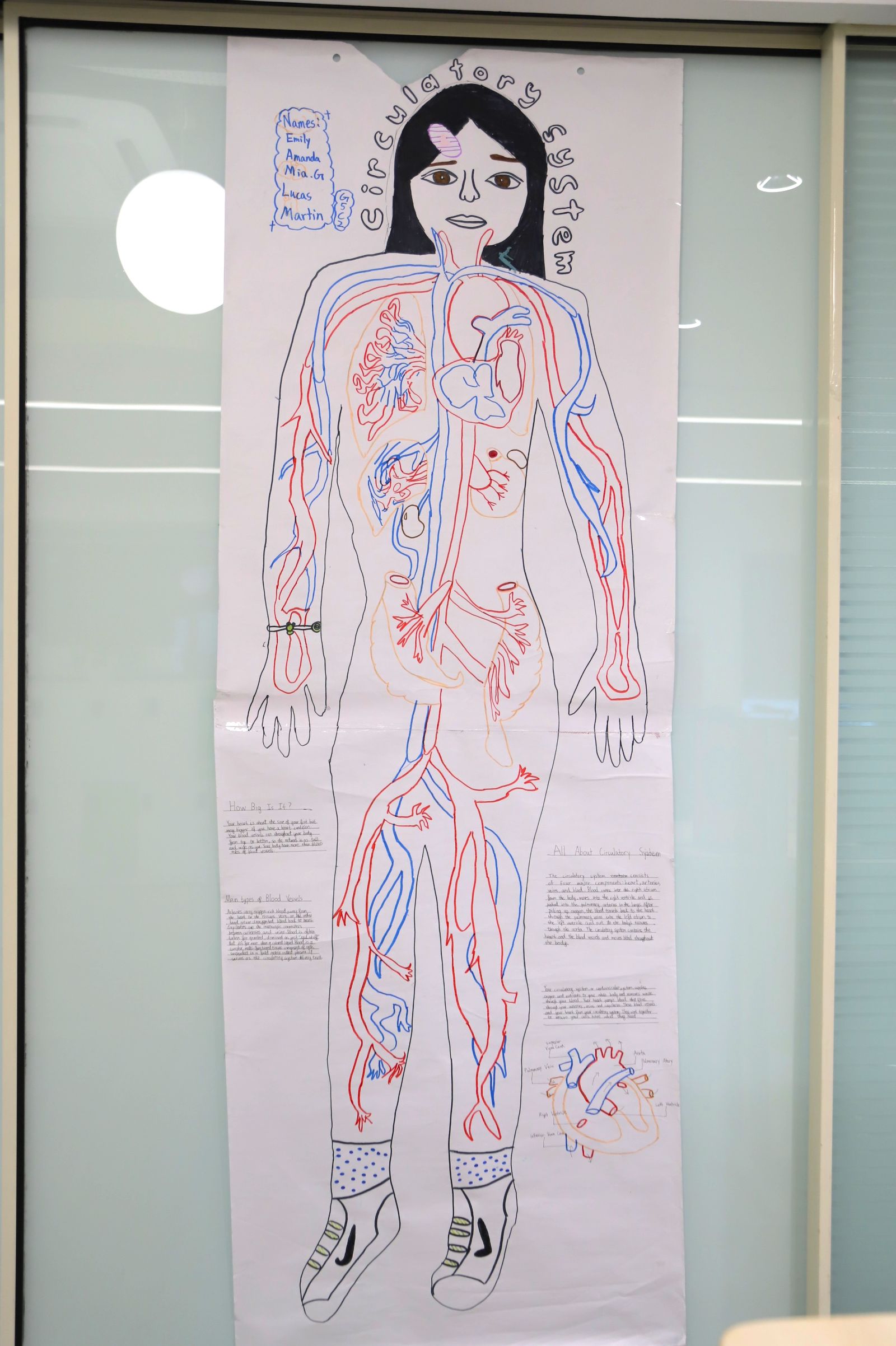
Through hands-on practice and teamwork, they deepened their understanding of complex human mechanisms while demonstrating integrated growth in cross-disciplinary inquiry, collaboration, and communication.
Looking back on this vibrant and fulfilling semester—from careful word choice in Chinese lessons to logical construction in mathematics, from confident expression in English to hands-on validation in science—students at Dehong Shanghai Elementary School have gained not only solid knowledge and skills, but also developed learning dispositions of thinking actively, exploring joyfully, and expressing bravely through every question, collaboration, creation, and presentation. We believe education is not merely about transmitting knowledge, but about inspiring thinking, broadening horizons, and shaping character. Dehong’s integrated bilingual curriculum and inquiry-based pedagogy are designed to connect learning with the real world and align with each child’s developmental rhythm. Looking ahead, may our students continue—with curious eyes, exploring hands, and warm hearts—to take root deeply and grow upward on this fertile ground called Dehong.