

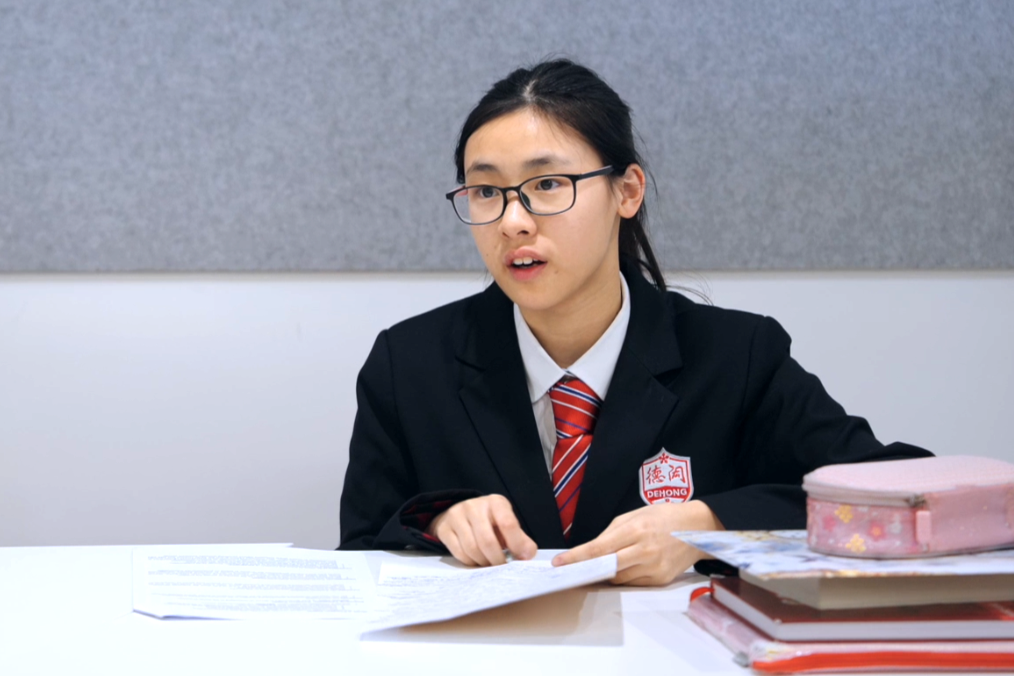
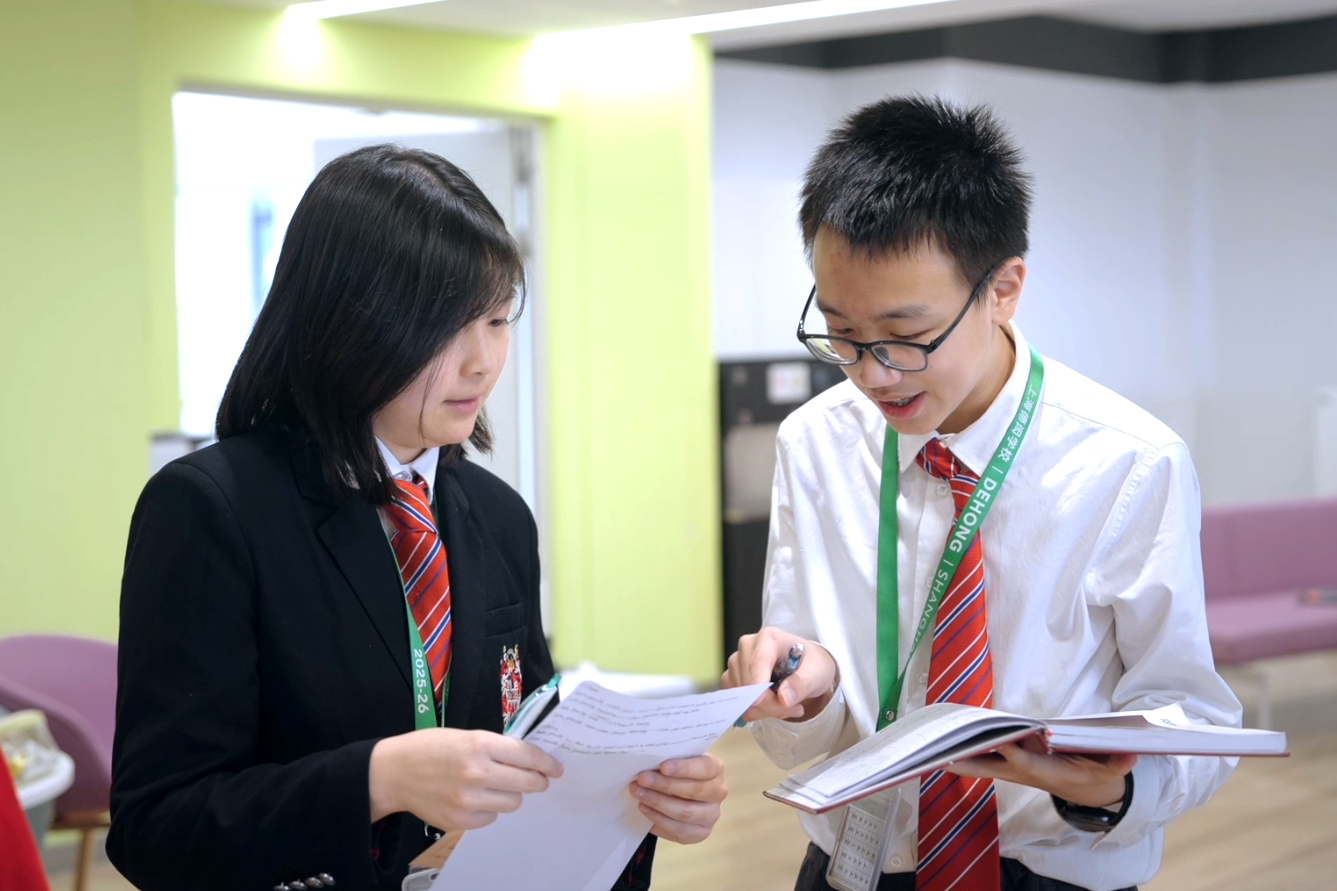
Recently, Grade 8 students at Dehong Shanghai took part in a distinctive Global Perspectives lesson—a fully English Model United Nations (MUN) simulation. Stepping into the roles of “diplomats,” students represented countries such as the United Kingdom, Brazil, Tanzania, Italy and India, each at different stages of economic and political development and facing diverse social challenges. In English, students presented their countries’ current contexts, key needs and negotiable resources, engaged in informal consultations, and sought like-minded partners. Through collaboration, they worked towards addressing shared challenges and developing collective solutions.
Model United Nations (MUN) is a scenario-based learning activity centered on global issues. Students take on the roles of country representatives and work collaboratively in simulated international conferences to explore and address real-world challenges such as climate change, poverty, gender equality, and resource security. Through pre-conference research and opening statements, students articulate their countries’ positions; through discussion and negotiation, they build alliances, co-develop solutions, and jointly draft and vote on resolutions.
Throughout the process, students exchanged views, built alliances and co-developed proposals, gaining an in-depth understanding of international affairs through authentic role-play. This activity formed a core component of the Global Perspectives curriculum and represented a meaningful interdisciplinary integration of Geography, History, Politics, Economics and English. In a fully English-speaking environment, students experienced the complete process—from research and presentation to negotiation and resolution—strengthening essential skills such as public speaking, negotiation, collaboration and problem-solving in a global context.
Why Model UN as a Classroom Practice?
The Global Perspectives team at Dehong Shanghai firmly believes that in an increasingly globalised world, understanding international relations and developing intercultural communication skills are essential competencies for future-ready learners. The Global Perspectives curriculum consistently connects classroom learning with the real world, and MUN serves as a powerful platform to achieve this goal. The experience goes beyond applying subject knowledge—it is a comprehensive exercise in critical thinking and transferable skills.
One of the core skills developed through Model UN is empathy. Students must understand different perspectives, think from the viewpoints of other countries and regions, and engage with issues they may not typically encounter in their current context in China. At the same time, they need to think strategically: Who could be potential allies? Where should negotiations take place? How can they persuade others to support their proposals? The process emphasizes both teamwork and the clarity and logic of individual expression.
——Nicola Bax, SS Global Perspectives Teacher
What Unique Experiences and Insights Did Our Young Diplomats Gain?
My key focus areas included wealth inequality, gender equality, and environmental challenges such as access to clean water and air pollution. This experience taught me to view complex social issues in a more balanced and comprehensive way, and helped me realise that not all problems can be solved as easily as textbooks suggest.
At first, cooperation was limited to one or two countries, but as discussions deepened, it evolved into multilateral collaboration. We eventually proposed the establishment of an international bank to provide loans for charitable projects, addressing poverty and gender inequality collectively.Through collaboration, we explored more sustainable solutions to global challenges.
——G8 Lucy, Representative of the Republic of India
Our focus was on improving education quality while addressing economic development issues. This experience reshaped my understanding of international cooperation. I used to think cooperation mainly involved direct exchanges of resources or benefits. Now I see that it can take many forms—such asvisa facilitation policies that promote mobility for learning and work, enabling deeper collaboration between countries.
Working with three countries that did not always share the same stance challenged me to communicate, negotiate and find common ground despite differences.
——G8 Anna, Representative of the French Republic
My main proposal focused on responding to global economic downturns and securing and allocating resources effectively. As discussions progressed, I realised that beyond bilateral cooperation, it was essential to articulate persuasive arguments in broader multilateral forums. I also gained a deeper understanding that global issues extend beyond economics to include climate change and world peace.
The biggest takeaway for me was the improvement in communication skills—learning how to adjust my expression to ensure clarity and mutual understanding in international dialogue.
——G8 Jimmy, Representative of the United Kingdom of Great Britain and Northern Ireland
The country I represented faces limitations in military and economic resources and has a complex social structure shaped by diverse regions and communities.
Through Global Perspectives learning and practice, I truly understood the importance of viewing issues from multiple perspectives. This ability helps us remain open-minded, gather broader information, and better understand unfamiliar challenges—ultimately leading to more effective solutions.
——G8 Gordon, Representative of the United Republic of Tanzania
MUN is a representative example of the rich and thoughtfully designed Global Perspectives curriculum at Dehong Shanghai Secondary School. As a distinctive interdisciplinary subject, Global Perspectives integrates economics, business, environmental systems, sociology, geography and history, and serves as a cornerstone of project-based learning at the middle school level. Each term, students explore different interdisciplinary themes and work towards practical solutions to real-world issues—such as weather and microclimates in Grade 6, or population change in Grade 7. The subject aims to develop critical thinking, problem-solving, collaboration and communication skills, while deepening students’ understanding of a diverse and interconnected world.
The Global Perspectives curriculum at Dehong Shanghai middle school is carefully aligned with students’ progression into high school. At the middle school stage, we focus on building essential skills step by step—such as evaluating reliable sources and completing small-scale research projects in Grade 6, before moving on to more complex global issues in Grade 8. Students learn to assess the credibility of information and consider how they can make a positive impact as global citizens.
——Nicola Bax, SS Global Perspectives Teacher
At Dehong Shanghai, learning is never limited to one-way textbook instruction. Across subjects, students actively participate in interdisciplinary, inquiry-based experiences that allow them to see how knowledge applies in the real world. Looking ahead, Dehong Shanghai will continue to expand immersive, cross-disciplinary learning opportunities—ensuring that every student not only strives for academic excellence, but is also well prepared in language proficiency, global perspectives and essential skills to meet the real-world challenges of the future global stage.